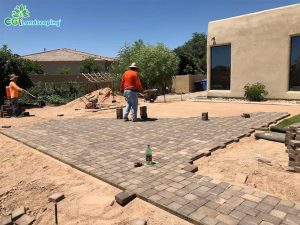
Desert landscapes demand precision, not shortcuts. Surface materials expand, soils shift, and sunlight accelerates wear. When these realities are ignored, paved areas fail faster than expected. At CGL Landscaping, projects are planned with climate logic, not generic templates. This guide analyzes Common Mistakes in Paver Installation in Arizona Landscapes, explaining where failures begin and how informed planning prevents them. The discussion also clarifies why Paver Installation requires technical discipline rather than aesthetic focus alone.
1. Ignoring Native Soil Conditions
Arizona soils vary widely, from caliche-heavy ground to loose sandy bases. A common mistake is assuming uniform compaction behavior. When installers skip soil testing, load-bearing capacity is misjudged. Over time, this causes differential settlement, surface cracking, and misaligned joints. We often see patios that look perfect at completion but are shifted within one seasonal cycle due to untreated subgrade instability.
Moisture retention rates and the level of minerals in the soil must dictate how the soil is prepared. If expansive soils are present, mechanical compaction will not be enough by itself. Stabilization layers and correct base depth are non-negotiable. In mixed-use landscapes, adjacent features such as Commercial SOD installation in Mesa, AZ, can further alter moisture dynamics, increasing movement if soil profiles are not properly separated.
2. Improper Base Layer Thickness
Base depth errors account for a high percentage of early paver failures. Many installations rely on minimal aggregate layers to reduce material costs. In high-heat regions, thermal expansion places additional stress on thin bases.
A structurally sound base distributes loads evenly and resists erosion during monsoon runoff. Standards recommend deeper bases in desert climates due to soil volatility. When this step is rushed, even premium pavers underperform. We have observed that landscapes combining hardscape and Commercial SOD installation require even stricter base separation to prevent water migration and base saturation.
3. Skipping Proper Drainage Design
Drainage is often treated as an afterthought. Flat installations without slope control trap water beneath the surface. In Arizona, sudden rainfall events intensify this issue. Trapped moisture weakens base materials and accelerates joint sand loss. Eventually, the voids developed, becoming a risk factor for the structural stability.
Effective drainage design includes grading, edge control, and subsurface channels. Water must be directed away from paved zones, not allowed to pool. This becomes critical when lawns or Commercial SOD installation are nearby, as irrigation runoff can infiltrate paved sections if drainage paths are not clearly defined.
4. Using Incorrect Jointing Materials
Joint sand selection directly affects paver longevity. Basic sand washes out quickly under heavy rain or frequent cleaning. Once joints open, pavers shift independently, increasing surface instability. This mistake is common in budget-focused installations where long-term performance is underestimated.
Polymeric jointing compounds are engineered to resist erosion and inhibit weed growth. However, incorrect application negates their benefits. Timing, moisture control, and compaction cycles must align. We have seen projects where improper jointing caused failure even when base layers were correctly built, especially near irrigated Commercial SOD installation in Mesa, AZ zones.
5. Poor Edge Restraint Installation
Edge restraints are structural components, not cosmetic details. When they are weak or inconsistently anchored, lateral movement becomes inevitable. High temperatures expand pavers outward, and without firm containment, edges separate and sink.
Durable restraints must be anchored below grade and secured to stable soil. Adhesives alone are insufficient in desert conditions. This issue often appears along transitions between paved areas and turf features like Commercial SOD installation, where soil moisture differences accelerate edge displacement.
6. Neglecting Thermal Expansion Gaps
Heat management is critical in arid environments. Pavers expand during peak temperatures and contract at night. Installations that ignore expansion tolerances develop surface buckling or cracked units. Tight spacing may look clean initially, but it fails under thermal stress.
Correct spacing allows controlled movement without structural damage. This principle applies to all hardscape scales, from walkways to drive lanes. When expansion gaps are overlooked, repairs become frequent and costly. We recommend planning thermal movement alongside irrigation layouts used in Commercial SOD installation to avoid compounded stress zones.
7. Rushing the Curing and Compaction Process
Final compaction is not a single-step task. Rushed timelines often skip multiple vibration passes needed for proper interlock. Without gradual settling, pavers remain loosely seated, making them vulnerable to displacement.
Curing time allows materials to stabilize under real conditions. Traffic or furniture placement too soon disrupts alignment. We have seen landscapes where impatience undermined weeks of preparation. This mistake is amplified in properties that also include Commercial SOD installation, as early irrigation increases sub-base moisture before stabilization is complete.
Conclusion
Longevity in desert hardscape is achieved through methodical planning, not shortcuts. Each mistake discussed originates from underestimating climate-specific forces. CGL Landscaping approaches every project with structural foresight and material discipline. Understanding these errors clarifies why Paver Installation in Arizona demands specialized execution. When technical standards are respected, paved landscapes maintain alignment, safety, and visual consistency for years.
Call to Action
If surface shifting, drainage issues, or premature wear are concerns, professional evaluation matters. CGL Landscaping makes available climate-resilient hardscaping options that are well-suited for functionality and longevity. For professional advice and organized hardscaping installation design, get in touch with us at (480) 219-0038.
FAQs
1. Why do pavers fail faster in desert climates?
There is also perpetual movement on the surface due to extreme temperatures, unstable soil, and rainfall. The materials cannot accommodate this stress without base depth, drainage, or proper spacing, and this results in misalignment and early failure.
2. How does nearby turf affect paver performance?
Adjacent turf areas, including Commercial SOD installation in Mesa, AZ, introduce additional moisture into the soil. If separation layers and drainage controls are missing, this moisture migrates under pavers, weakening the base and accelerating settlement or joint erosion.
3. Is maintenance different for desert-installed pavers?
Yes. It is important to have regular inspections around joints, edges, and drainage paths. The heat and dust contribute to the faster degradation of joint materials. Preventive maintenance costs are lower than repairs, and it is also a good way to keep the structure safe in hot places.